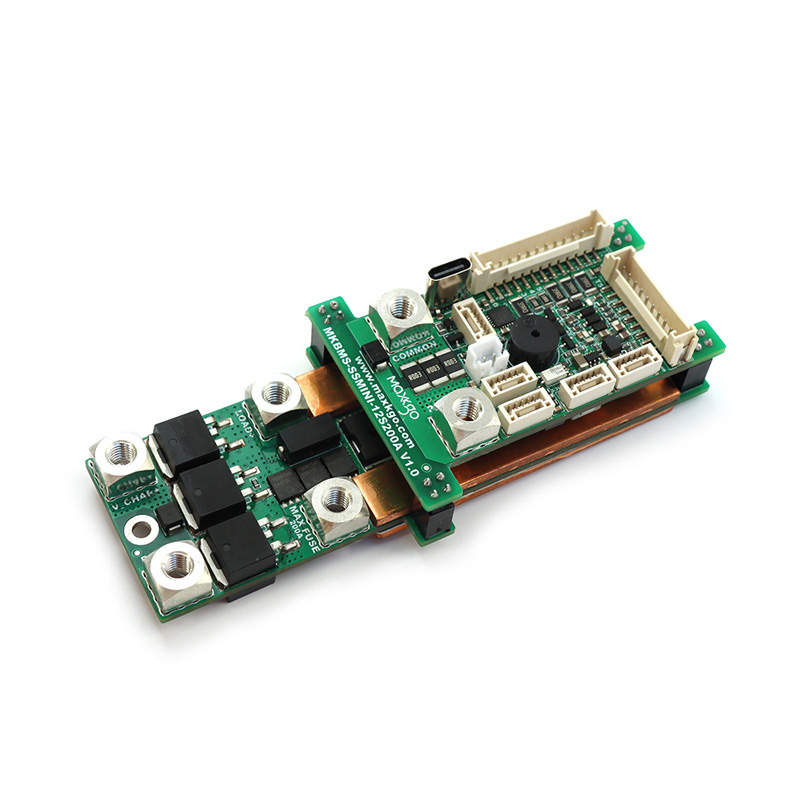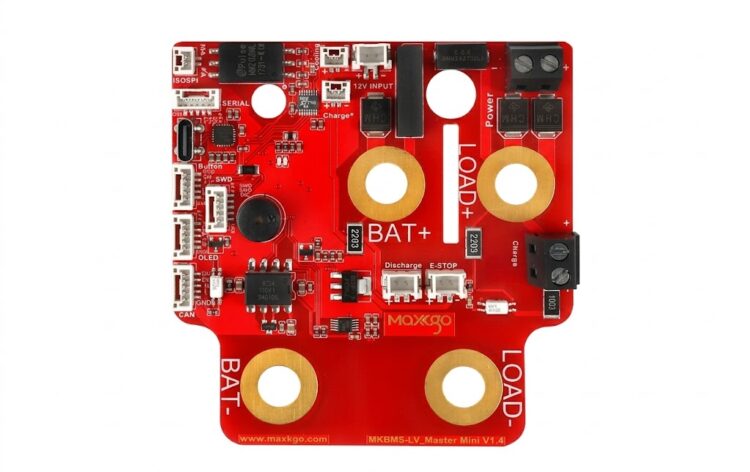

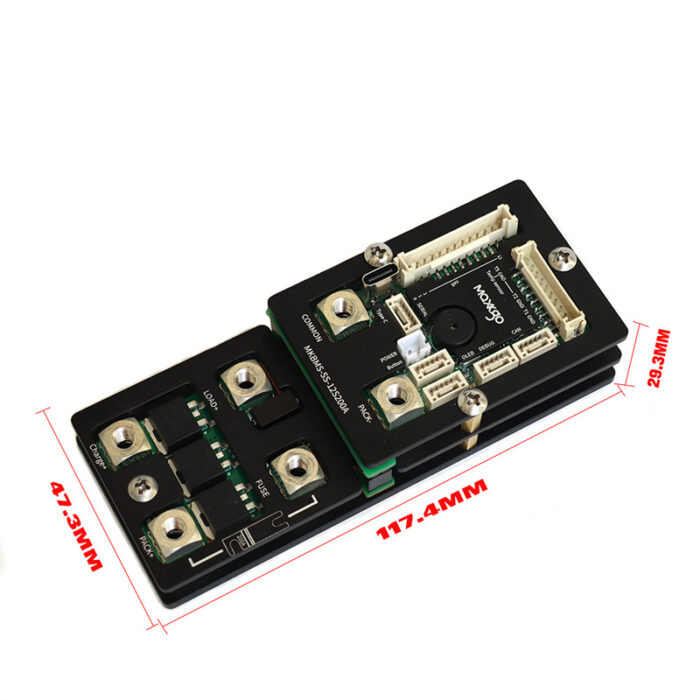
Choosing a 12S smart BMS requires more than checking the battery’s series count. You also need to consider discharge current, charging capacity, cell balancing, temperature protection, and communication interfaces. If your battery pack powers an electric skateboard, e-bike, robot, or energy storage system, an unsuitable battery management system can limit performance or compromise battery safety. You need a solution that matches your pack configuration and operating conditions. The MAXKGO-SS 12S 200A Smart BMS combines battery monitoring, configurable protection, and multiple communication interfaces in one system. With support for 6S–12S lithium battery packs, up to 200A discharge current, and up to 50A charging current, it provides a practical starting point for engineers and equipment manufacturers evaluating high-current battery management solutions.
What Is a 12S Smart BMS?
A 12S smart battery management system monitors and protects a lithium battery pack configured with 12 cells or cell groups connected in series. The actual pack voltage depends on the battery chemistry and its specified operating limits.
Unlike a basic protection board, a smart BMS can provide battery status information, current monitoring, configurable protection settings, and communication with compatible external devices. These capabilities help you evaluate battery condition and integrate protection functions into your equipment.
The MAXKGO-SS supports 6S–12S configurations, making it suitable for projects that require flexibility across different battery pack designs.
Key Features of the MAXKGO-SS 12S Smart BMS
1. High-Current Charging and Discharging
Current capacity is a critical selection factor for electric mobility and other power-intensive applications. The MAXKGO-SS supports:
- Maximum discharge current: 200A
- Maximum charging current: 50A
- Supported battery configuration: 6S–12S
- Cell balancing current: 86mA
These ratings help you assess whether the BMS fits your battery and load requirements. However, you should also verify continuous versus peak current ratings, cooling conditions, wiring capacity, and protection thresholds before finalizing your design.
2. Battery Monitoring and Protection
The 12S smart BMS integrates several functions designed to help protect lithium battery packs during normal operation and fault conditions.
Key functions include:
- Overcharge and over-discharge protection
- Overcurrent and short-circuit protection
- Charge and discharge temperature protection
- Battery voltage and bidirectional current monitoring
- State of charge (SOC) estimation using coulomb counting
- Battery capacity and internal resistance detection
- Configurable voltage, current, and temperature thresholds
For example, an electric skateboard may experience rapid current changes during acceleration and climbing. Appropriate current limits and temperature thresholds help the battery management system respond to operating conditions while supporting the equipment’s protection strategy.
3. CAN and UART Communication
A battery management system needs to communicate effectively with compatible controllers, displays, and monitoring tools. The MAXKGO-SS provides USB-C, UART, I²C, and isolated CAN interfaces.
CAN communication can support integration into systems with compatible vehicle controllers or other electronic modules. UART provides another option for serial communication and configuration.
The BMS also supports an OLED display, buzzer, and status LED. Before integration, confirm the communication protocol, connector pinout, voltage levels, and software compatibility with your target equipment.

MAXKGO-SS Specifications at a Glance
| Parameter | Specification |
|---|---|
| Product model | MAXKGO-SS |
| Main keyword category | 12S smart BMS |
| Supported series configuration | 6S–12S |
| Maximum discharge current | 200A |
| Maximum charging current | 50A |
| Cell balancing current | 86mA |
| Communication interfaces | USB-C, UART, I²C, isolated CAN |
| Protection functions | Voltage, current, temperature, short circuit |
| Enclosure | Aluminum alloy |
| Compatible software tools | MAXKGO-BMS-TOOL and ENNOID-BMS-TOOL |
Applications of a 12S 200A Smart BMS
A high-current BMS can support several types of battery-powered equipment, provided its electrical ratings and control interfaces match the application.
- Electric skateboards and e-bikes: Manage battery operating limits during acceleration, climbing, and repeated riding cycles.
- Robotics: Monitor battery condition and support protection requirements in mobile robots and other battery-powered machines.
- Electric scooters and tricycles: Provide battery monitoring and protection for suitable lithium battery configurations.
- Energy storage systems: Help monitor battery status in compatible storage designs.
- Solar-powered equipment: Support battery protection where the pack configuration and charging system are compatible.
The MAXKGO-SS is not automatically suitable for every EV or storage project. Check battery chemistry, pack voltage, peak and continuous current, thermal conditions, and controller compatibility before selecting it.
How to Select and Integrate a 12S Smart BMS
Follow these steps to reduce compatibility issues during development:
- Confirm the battery configuration. Verify the series count, cell chemistry, cell specifications, and operating voltage range.
- Calculate current requirements. Compare the expected continuous and peak discharge current, as well as the maximum charging current, with the BMS ratings.
- Review protection settings. Set appropriate voltage, temperature, and current limits according to the battery manufacturer’s requirements.
- Check communication compatibility. Confirm CAN or UART protocol details, wiring, and software support before connecting external controllers.
- Validate the complete system. Have qualified personnel verify wiring, cooling, charging behavior, and protection responses under controlled test conditions.
This process helps you determine whether the BMS fits your application before committing to a production design.
FAQ
1. Can a 12S smart BMS support a 200A load?
The MAXKGO-SS is rated for up to 200A discharge current. Confirm whether your application requires continuous or peak current and verify the applicable operating conditions before use.
2. Does the MAXKGO-SS support CAN and UART?
Yes. It provides isolated CAN, UART, USB-C, and I²C interfaces. You should confirm protocol and pinout compatibility with your controller before integration.
3. Can this 12S BMS be used for energy storage or robotics?
It can be considered for compatible energy storage and robotics applications. Suitability depends on battery chemistry, series configuration, current requirements, thermal design, and system-level protection requirements.
Conclusion
Selecting the right 12S smart BMS means balancing current capacity, battery protection, communication, and application requirements. The MAXKGO-SS offers 6S–12S support, up to 200A discharge current, up to 50A charging current, 86mA cell balancing current, and multiple communication interfaces. These features make it worth evaluating for compatible electric mobility, robotics, and energy storage projects. By checking your battery specifications and integration requirements early, you can make a more informed BMS selection.
CTA
Contact MAXKGO to discuss your battery configuration, current requirements, and communication needs. Share your cell chemistry, series count, charging current, expected discharge load, and controller interface so the team can help you evaluate whether the MAXKGO-SS 12S 200A Smart BMS fits your project.