


When you design a high-voltage battery pack, reliable cell monitoring, coordinated control, and scalable system architecture become essential engineering considerations. A high voltage BMS helps you manage battery operation while supporting the protection and monitoring functions required by your application. However, selecting a suitable system involves more than checking its voltage range. You also need to evaluate communication interfaces, master-slave architecture, firmware compatibility, and integration requirements. MAXKGO addresses these needs with its HV Master BMS, a modular battery management system designed for battery configurations operating at voltages up to 400V. With CAN communication, an ISOSPI interface, USB-C connectivity, and an OLED display, this master board provides a configurable foundation for developers building electric mobility, robotics, and other intelligent power systems.
What Is a High Voltage BMS?
A high voltage battery management system monitors and manages a battery pack through connected sensing, control, and communication hardware. Depending on its design, a BMS can support cell-voltage monitoring, temperature monitoring, balancing, fault detection, and protective responses.
For high-voltage applications, the system architecture matters because the battery pack may contain multiple cell groups and require coordinated communication between monitoring boards and the main controller.
MAXKGO’s HV Master BMS is designed around a modular master-slave architecture. Rather than relying on a single fixed board configuration, you can connect one or more slave boards and compatible integrated boards through the ISOSPI interface.
This approach gives developers greater flexibility when configuring battery management hardware for different pack sizes and application requirements.
Key Features of the MAXKGO High Voltage BMS
1. Configurable Operation Up to 400V
The MAXKGO HV Master BMS supports configurable battery systems operating within a voltage range of 100V to 400V. This makes it a candidate for projects that require a high-voltage battery management architecture rather than a conventional low-voltage BMS.
Before selecting the board, you should confirm your battery’s nominal and maximum operating voltages, cell configuration, and the voltage limits of every connected component.
2. Modular Master-Slave Architecture
The master board connects to one or more slave boards and compatible integrated boards through ISOSPI. This arrangement allows you to organize battery monitoring hardware according to your system design.
Potential benefits include:
- Flexible configuration for different battery pack layouts.
- Distributed cell-monitoring hardware where supported by the connected boards.
- Easier adaptation of the BMS architecture to project-specific requirements.
- A common master-controller structure for coordinating connected modules.
The final number of supported cells and slave boards depends on the selected hardware configuration and compatible firmware.
3. CAN, USB-C, and OLED Interfaces
Communication and access to system information are important when developing and testing a battery management system.
The HV Master BMS includes CAN, USB-C, and an OLED display. These interfaces can support system integration, development workflows, and local status visibility, subject to the capabilities of the selected firmware and hardware revision.
CAN is particularly relevant when you need to integrate the BMS with other electronic controllers. Before implementation, verify the supported CAN protocol, message definitions, connector pinout, and communication settings.
4. LTC68XX, STM32, and ENNOID Compatibility
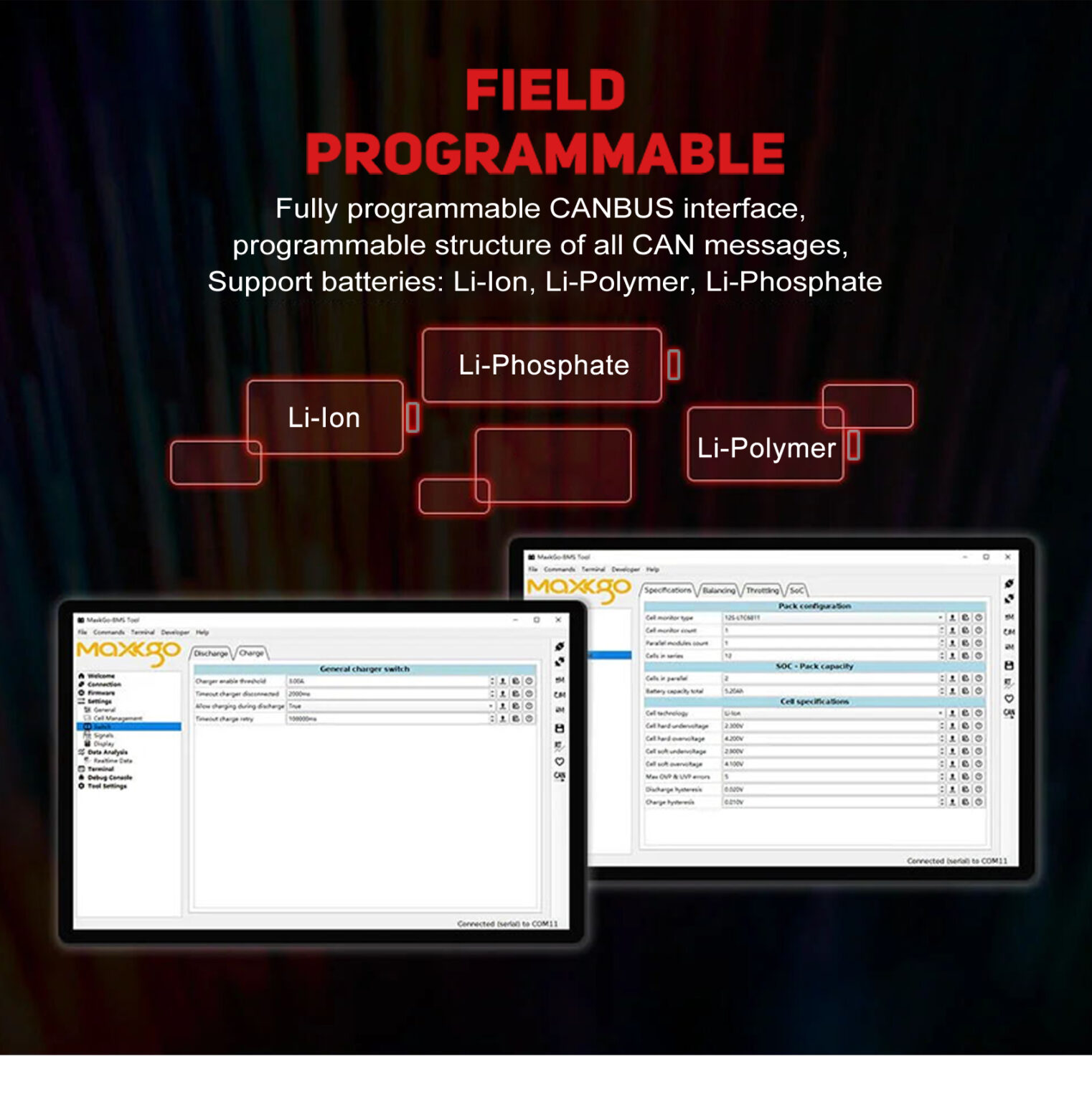
The MKBMS platform is designed for modular battery management systems using LTC68XX-related monitoring hardware and STM32 microcontrollers. MAXKGO also states that the product is compatible with ENNOID firmware and was developed with reference to open-source materials from DieBieMS and ENNOID BMS.
For engineering teams, firmware compatibility can reduce the need to develop an entirely new control framework. Nevertheless, you should confirm the exact hardware revision, firmware version, configuration procedure, and supported monitoring components before deployment.
High Voltage BMS vs. Conventional Low Voltage BMS
The appropriate BMS depends on your battery architecture and application requirements. The following comparison highlights general design considerations rather than claiming that every low-voltage or high-voltage system shares identical capabilities.
| Comparison factor | MAXKGO HV Master BMS | Conventional low-voltage BMS |
|---|---|---|
| Voltage application | Configurable systems within 100V–400V | Typically designed for lower-voltage battery packs |
| Architecture | Modular master-slave configuration | May use integrated or modular hardware |
| Communication | CAN and ISOSPI interfaces | Depends on the selected model |
| Controller platform | STM32-based system compatibility | Varies by product |
| Firmware | Compatible with ENNOID firmware | Depends on the manufacturer |
| Integration priorities | High-voltage design and modular communication | Requirements depend on pack size and application |
Applications of a Modular High Voltage BMS
A modular BMS can be useful when your equipment requires coordinated battery monitoring across multiple cell groups.
MAXKGO identifies the following application areas for its HV Master BMS:
- Electric vehicles: Battery monitoring and control-system integration for compatible vehicle platforms.
- Electric patrol and sightseeing vehicles: Modular battery management for electric transport applications.
- Automatic forklifts and handling robots: Battery monitoring for industrial mobility and material-handling equipment.
- Electric bicycles and skateboards: Potential use in compatible high-voltage configurations, subject to the product’s electrical specifications.
- Consumer and industrial robots: Battery management hardware for robotics projects with suitable voltage and communication requirements.
- Electric tools: Integration into compatible battery-powered equipment.
These are potential application areas, not confirmation that the board is suitable for every device in each category. You should assess electrical, mechanical, environmental, and regulatory requirements for your specific project.
How to Select and Integrate a High Voltage BMS
Follow these steps when evaluating the MAXKGO HV Master BMS for your project.
- Define your battery specifications. Document nominal voltage, maximum voltage, cell chemistry, series-cell count, current requirements, and operating temperature.
- Determine the monitoring architecture. Identify the required slave boards, integrated boards, cell-monitoring components, and ISOSPI connections.
- Verify communication requirements. Check CAN protocol compatibility, USB-C functionality, connector assignments, and controller integration.
- Confirm firmware compatibility. Verify the appropriate ENNOID firmware version, configuration settings, and supported hardware revision.
- Review safety and compliance requirements. Evaluate insulation, creepage and clearance, contactor control, overcurrent protection, fault handling, and applicable product standards. Do not assume these functions or certifications are included without confirmation.
- Validate the complete system. Have qualified engineers review the design and conduct controlled testing before operating the battery at high voltage.
FAQ
1. What voltage range does the MAXKGO HV Master BMS support?
The product is configurable for battery systems operating within 100V to 400V. Confirm the precise voltage limits and compatible cell configurations with MAXKGO before purchasing.
2. Does the HV Master BMS support CAN communication?
Yes. The product specifies CAN connectivity, alongside USB-C, an OLED display, and an ISOSPI interface. Check the documentation for the relevant protocol and integration details.
3. Is the MAXKGO HV Master BMS compatible with ENNOID firmware?
MAXKGO states that MKBMS is compatible with ENNOID firmware. Confirm the applicable firmware version and hardware configuration before integrating it into your battery system.
Conclusion
Choosing a high voltage BMS requires careful evaluation of voltage limits, modular architecture, communication interfaces, firmware support, and system-level safety. MAXKGO’s HV Master BMS offers a configurable 100V–400V platform with CAN, USB-C, OLED, and ISOSPI connectivity for compatible electric mobility, robotics, and intelligent power applications. By confirming your battery specifications and integration requirements early, you can determine whether this modular master board fits your project.
Request a technical consultation from MAXKGO. Share your battery voltage range, cell configuration, required slave boards, CAN integration requirements, and intended application through the MAXKGO product inquiry page. The team can help you clarify hardware compatibility and identify the specifications you need to verify before implementation.
