



Das Richtige wählen Drohnen-ESC ist unerlässlich, wenn Sie eine leistungsstarke FPV-Drohne oder ein industrielles UAV bauen. Ein unterdimensionierter elektronischer Geschwindigkeitsregler kann mit hohen Stromanforderungen zu kämpfen haben, während eine inkompatible Batteriespannung oder ein inkompatibles Kommunikationsprotokoll die Systemintegration erschweren kann. Diese Probleme können die motorische Reaktion beeinträchtigen, Leistungsabgabe, und allgemeine Flugzuverlässigkeit.
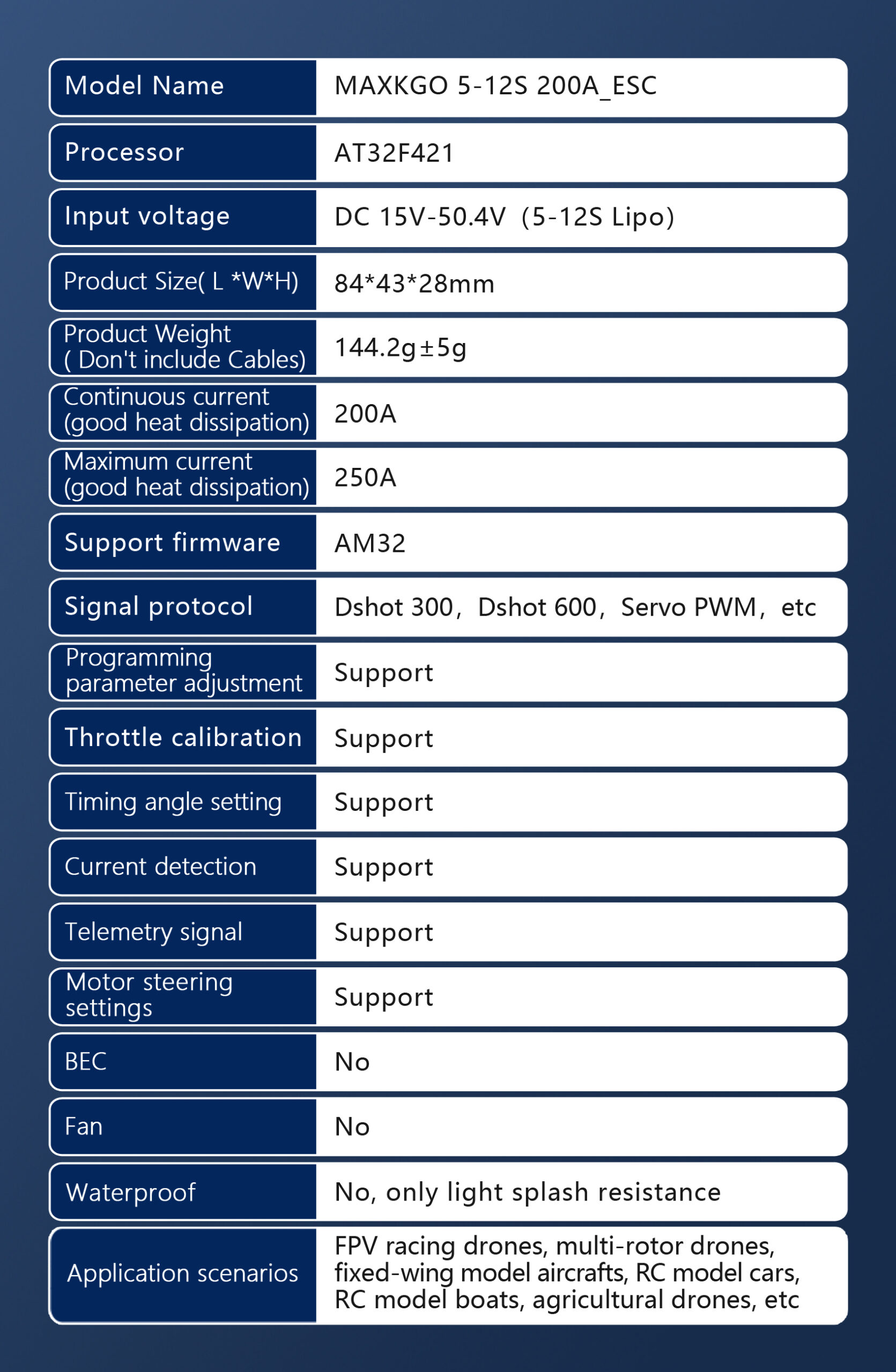
Wenn Ihr Projekt einen kompakten Controller mit erheblicher Stromkapazität erfordert, Der Maxkgo 5-12S 200A MINI ESC ist eine Bewertung wert. Es unterstützt 5S–12S LiPo-Akkus, liefert 200A Dauerstrom, und bewältigt Burst-Ströme bis zu 250 A. Mit AM32-Firmware-Kompatibilität und DShot-Telemetrie, Es bietet mehrere wichtige Funktionen für anspruchsvolle Drohnenantriebssysteme.
Was macht einen Hochstrom-Drohnen-Regler für UAV-Anwendungen geeignet??
Ein Drohnen-ESC (Elektronischer Geschwindigkeitsregler) regelt die elektrische Leistung, die einem bürstenlosen Motor zugeführt wird. It receives control signals from the flight controller and adjusts motor speed according to the required operating conditions.
For high-power UAV applications, you need to evaluate more than the rated current. Battery compatibility, firmware, communication protocols, Wärmemanagement, and protection functions also influence your selection.
The Maxkgo 200A MINI ESC combines several specifications for high-current applications:
- Battery compatibility: Supports 5S–12S LiPo batteries.
- Dauerstrom: Rated at 200A for sustained power delivery within specified operating conditions.
- Burst current: Supports up to 250A during short-duration high-load conditions.
- Firmware: Compatible with AM32 configuration tools.
- Processor: Uses a high-performance ARM Cortex MCU.
- Kommunikation: Supports DShot telemetry and advanced communication protocols.
- Schutz: Includes multiple protection functions to support safer operation.
These features make the controller suitable for projects that require substantial electrical capacity and flexible configuration.
Why Choose a 5-12S 200A Brushless ESC?
When designing a large multirotor or industrial UAV, your propulsion system must handle the combined electrical demands of its motors. A high-current brushless ESC helps manage these demands without requiring you to compromise on the intended motor configuration.
1. High Current Capacity for Demanding Loads
The 200A continuous rating provides a reference point when matching the ESC to your motor and battery system. Its 250A burst rating also accommodates short-duration current peaks, provided the operating conditions remain within the manufacturer’s specifications.
Vor der Installation, check the motor’s expected current consumption, battery discharge capability, Verdrahtung, Anschlüsse, and cooling arrangements. The ESC’s rated current alone does not determine the capacity of the complete propulsion system.
2. Flexible 5S–12S Battery Compatibility
Battery voltage directly affects motor speed, power requirements, and electrical system design.
The Maxkgo 5-12S ESC supports 5S to 12S LiPo batteries, giving UAV developers flexibility when configuring different propulsion platforms. Jedoch, you should verify the actual battery voltage, motor specifications, and system limits before connecting the controller.
3. AM32 Firmware and DShot Telemetry
Firmware compatibility matters when you need to configure and maintain your propulsion system.
This 200A drone ESC supports AM32 configuration tools and DShot telemetry. These capabilities help developers integrate the controller into compatible electronic systems and access supported configuration and feedback functions.
The ARM Cortex MCU provides the processing platform for ESC operation. For a specific project, confirm the supported AM32 version, telemetry parameters, and flight controller compatibility before deployment.
200A Drone ESC vs. Other ESC Current Ratings
MAXKGO offers high-current ESC products, including 80A, 100A, 120A, and 200A models. Selecting the appropriate rating depends on your motor load and propulsion requirements.
| Selection Factor | Lower-Current ESC | Maxkgo 200A MINI ESC |
|---|---|---|
| Current rating | 80A–120A model classes | 200Eine kontinuierliche |
| Burst current | Check individual model specifications | 250A |
| Batterieunterstützung | Check individual model specifications | 5S–12S LiPo |
| Firmware | Abhängig vom Modell | AM32 compatible |
| Typical selection focus | Systems with lower current demands | High-current FPV and UAV systems |
The table compares product selection considerations, not independently verified performance results. Always check the specifications of the exact ESC model before purchasing.
Where Can You Use a High-Power FPV Drone ESC?
A high-current electronic speed controller can serve several types of brushless motor applications.
Common applications of the Maxkgo 200A MINI ESC include:
- High-power FPV drones: Supports propulsion systems designed for demanding flight and motor loads.
- Multirotor UAVs: Suitable for large multirotor configurations requiring high-current motor control.
- Starrflügler: Can be considered for compatible brushless propulsion systems.
- Industrial UAV platforms: Provides a high-current controller option for specialized unmanned aircraft projects.
- RC cars and boats: Supports compatible RC applications that require high-current brushless motor control.
For each application, verify motor compatibility, installation dimensions, cooling requirements, and electrical connections.
How to Select the Right 200A ESC for Your Drone
Before purchasing a high-current drone ESC, follow these steps to reduce compatibility problems during system integration.
- Calculate motor current requirements. Check the motor specifications and estimate the maximum current under your intended operating conditions. Make sure the ESC rating provides an appropriate operating margin.
- Confirm battery compatibility. Verify that your battery configuration falls within the supported 5S–12S LiPo range. Also check voltage limits throughout charging and discharging.
- Check firmware and communication protocols. Confirm that your flight controller supports the required AM32 configuration and DShot telemetry functions.
- Evaluate cooling and installation conditions. Berücksichtigen Sie den Luftstrom, Montageposition, Verdrahtungswiderstand, and heat dissipation. Actual current capacity can depend on operating temperature and cooling conditions.
- Verify protection and system integration. Review the available protection functions, wiring diagram, Anschlüsse, and installation instructions with your ESC supplier before final assembly.
Following these checks helps you select a controller that matches your propulsion system rather than relying on current ratings alone.
Why Consider MAXKGO as Your Drone ESC Supplier?
MAXKGO operates under Dongguan Daqianjin Technology Co., Ltd. Its technical background originated with the FLIPSKY team in 2017, whose founding members focused on DIY electric skateboarding and VESC-based electronic speed controllers.
In 2021, the company established the MAXKGO brand to focus on high-voltage, high-current battery management systems. It subsequently expanded into drone ESC development in early 2025, introducing 80A, 100A, 120A, and 200A product classes.
This development history gives the company experience across electronic control, Batterieschutz, and high-current applications.
Its manufacturing approach covers assembly and final inspection, with attention to production consistency and product reliability. MAXKGO also maintains dedicated inquiry and technical support channels for customers evaluating its BMS and ESC products.
When assessing a potential supplier, you can request relevant product test reports, applicable certificates, technical documentation, and quality inspection records to support your purchasing decision.
FAQ
1. What battery does the Maxkgo 200A drone ESC support?
The Maxkgo 5-12S 200A MINI ESC supports 5S–12S LiPo batteries. Check the battery’s voltage range and your motor specifications before installation.
2. What is the difference between continuous current and burst current?
Continuous current refers to the current an ESC is rated to handle under specified sustained operating conditions. Burst current refers to a higher current level supported for a limited period. The Maxkgo model is rated at 200A continuous and 250A burst current.
3. Is the Maxkgo 200A ESC suitable for FPV drones and industrial UAVs?
Ja. Its product applications include high-power FPV drones, multirotor UAVs, Starrflügler, and industrial UAV platforms. You should still confirm motor compatibility, battery configuration, Kühlung, and flight controller integration for your specific project.
Abschluss
Das Richtige auswählen Drohnen-ESC requires careful consideration of current capacity, Batteriespannung, Firmware-Kompatibilität, and operating conditions. The Maxkgo 5-12S 200A MINI ESC combines 200A continuous current, 250A burst current, 5S–12S LiPo compatibility, and AM32 support for high-power FPV and UAV applications.
Backed by MAXKGO’s experience in electronic control development and battery management systems, this model offers a practical option for developers building demanding brushless propulsion systems. By checking your motor requirements and system compatibility before purchasing, you can make a more informed ESC selection.
Looking for a 200A ESC for your next UAV or FPV project?
Kontakt MAXKGO to request detailed product specifications, technical documentation, and purchasing information. Our technical team can also help you confirm product compatibility and configuration requirements.