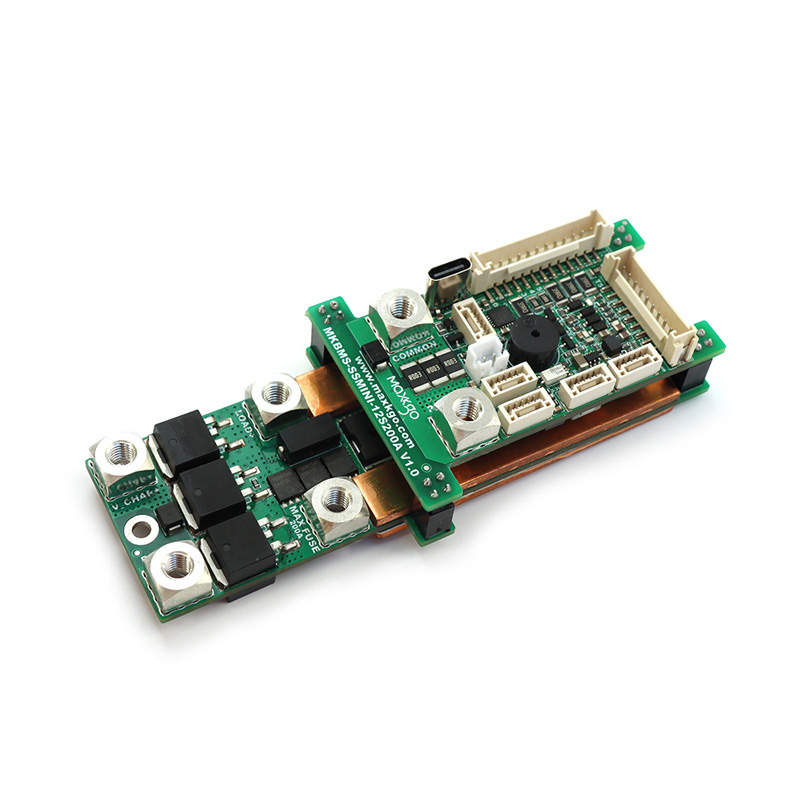


UN BMS à courant élevé plays a critical role in protecting lithium-ion battery packs that must deliver substantial power without compromising battery safety. Quand on construit un vélo électrique, an energy storage system, or a robotics platform, courant excessif, overcharging, short circuits, and temperature changes can affect battery performance and service life. Choosing a battery management system with suitable current capacity and protection functions helps you manage these risks.
Maxkgo offers an 8S–14S 150A Li-ion BMS protection board designed for 24V–48V lithium battery systems using ternary lithium-ion cells. With support for multiple battery configurations, équilibrage cellulaire, and separate charging and discharging ports, this high current BMS provides a practical option for developers and manufacturers building high-power battery packs. Understanding its specifications and application requirements will help you determine whether it fits your project.
What Makes a High Current BMS Suitable for Your Battery Pack?
A high current battery management system monitors battery operating conditions and provides protective functions when the system detects specified fault conditions. For high-power applications, you need to evaluate current capacity alongside battery configuration, protection features, and charging requirements.
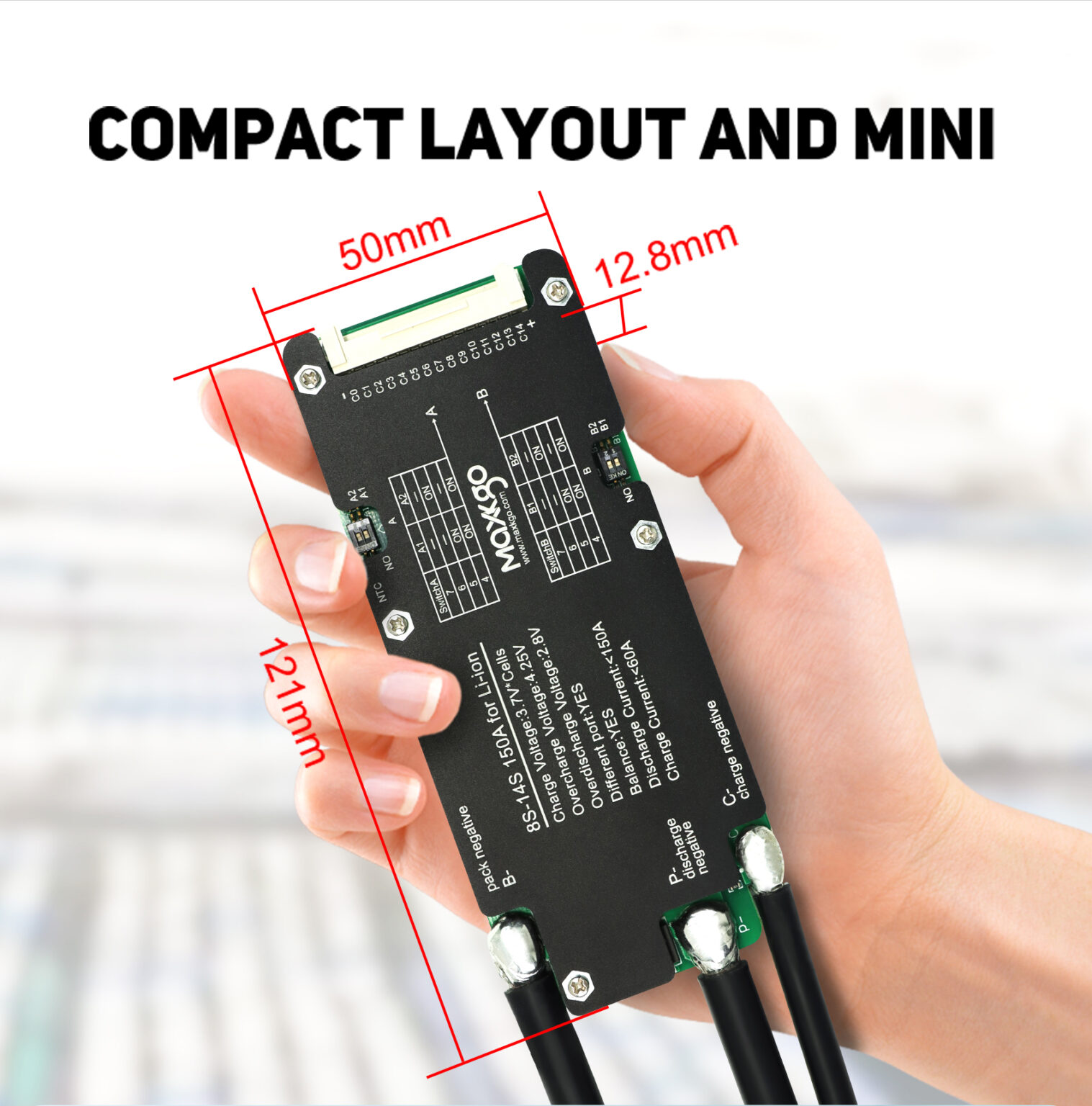
Maxkgo’s 150A BMS supports the following configurations:
- Battery configurations: 8S, 10S, 12S, and 14S.
- System voltage range: 24V–48V, depending on the battery configuration and operating conditions.
- Continuous discharge current: 150UN, according to the supplied product specifications.
- Battery chemistry: Ternary lithium-ion.
- Fonctions de protection: Surcharge, décharge excessive, surintensité, court-circuit, and temperature protection.
- Additional function: Équilibrage cellulaire.
- Port design: Separate charging and discharging ports.
These specifications help you assess whether the board matches your battery design. Cependant, you should also verify the operating limits, wiring requirements, conditions thermiques, and protection thresholds with Maxkgo before integrating the BMS into your equipment.
Key Protection Features of the 150A BMS
Protection contre les surcharges et les décharges excessives
Lithium-ion cells require controlled charging and discharging. Overcharging can create unsafe operating conditions, while excessive discharge can damage cells or reduce their usable life.
The Maxkgo lithium-ion battery protection board includes overcharge and over-discharge protection to help manage these risks. You should confirm the applicable voltage thresholds for your specific cell chemistry and series configuration before use.
Over-Current and Short-Circuit Protection
High-power equipment can draw substantial current during acceleration, startup, or changes in mechanical load. A suitable BMS helps protect the battery pack when current exceeds its configured limits.
Maxkgo specifies a 150A continuous discharge capability alongside over-current and short-circuit protection. Néanmoins, the 150A rating does not automatically establish the permissible short-circuit current, peak current, or protection response time. Check these parameters against your application’s requirements.
Protection de la température et équilibrage des cellules
Temperature protection helps the BMS respond to battery conditions outside its specified operating range. Entre-temps, cell balancing helps manage voltage differences between cells in a series-connected battery pack.
For an 8S–14S battery pack, balancing can support more consistent cell voltage management. Its effectiveness depends on the balancing method, actuel, cell condition, and charging profile, so confirm the detailed specifications with the manufacturer.
How to Choose the Right High Current BMS
Before purchasing a 150A BMS, compare the board’s specifications with your battery pack and equipment.
| Selection factor | Maxkgo 8S–14S 150A BMS | What you should verify |
|---|---|---|
| Battery configuration | 8S, 10S, 12S, 14S | Exact number of series-connected cells |
| System voltage | 24V–48V | Actual pack voltage and charging voltage |
| Continuous discharge | 150UN | Maximum sustained load and thermal conditions |
| Battery chemistry | Ternary Li-ion | Cell voltage limits and charging profile |
| Protection | Surcharge, décharge excessive, surintensité, court-circuit, température | Protection thresholds and response behavior |
| Équilibrage cellulaire | Soutenu | Balancing current and operating conditions |
| Charging and discharging | Separate ports | Wiring diagram and charger compatibility |
Steps to Check Compatibility Before Ordering
- Identify your battery chemistry. Confirm that your cells use a compatible ternary lithium-ion chemistry rather than assuming all lithium batteries share the same voltage limits.
- Determine your series configuration. Establish whether your battery pack uses 8S, 10S, 12S, or 14S cells in series.
- Calculate your current requirements. Evaluate continuous load current, startup demand, and peak current. Do not select a BMS based on nominal motor power alone.
- Review protection and balancing specifications. Ask for the relevant voltage thresholds, temperature limits, balancing parameters, and short-circuit response details.
- Confirm installation requirements. Check terminal connections, cable sizing, dispositions de refroidissement, and separate charging and discharging port wiring before installation.
Following these steps helps reduce compatibility issues and gives your engineering team a clearer basis for evaluating the battery protection board.
Applications of a 150A Li-ion BMS
A high current BMS can support several types of battery-powered equipment when its electrical specifications match the application.
- Electric bikes and electric mobility: Battery packs may require substantial discharge current during acceleration or climbing. Confirm that the BMS supports the motor controller’s actual current demand.
- Systèmes de stockage d'énergie: Battery packs used for backup power or custom energy storage require coordinated charging, discharging, and cell protection.
- Robotics and AGV/AMR platforms: Mobile robots may experience changing loads during movement, making current management and battery protection important design considerations.
- DIY and custom battery packs: Battery builders can evaluate the supported series configurations and separate ports when developing high-power lithium-ion battery systems.
Maxkgo focuses on BMS and electronic speed controller solutions, drawing on its background in DIY electric skateboarding and electronic control development. For application-specific projects, request technical documentation to confirm that the selected hardware meets your system requirements.
FAQ
1. What battery configurations does this 150A BMS support?
The product supports 8S, 10S, 12S, and 14S ternary lithium-ion battery configurations within the stated 24V–48V system range. Confirm the exact operating voltage and charging limits for your selected configuration.
2. Can I use this high current BMS for an electric bike?
Oui, il est destiné à des applications telles que la mobilité électrique et les vélos électriques. Avant l'installation, vérifier la chimie de la batterie, configuration en série, besoins en courant continu et de pointe, et compatibilité avec votre contrôleur de moteur.
3. Le Maxkgo BMS prend-il en charge l'équilibrage des cellules?
Oui. La carte comprend une fonction d'équilibrage des cellules ainsi que plusieurs fonctionnalités de protection de la batterie.. Contactez Maxkgo pour confirmer la méthode d'équilibrage, courant d'équilibrage, et d'autres paramètres de fonctionnement détaillés.
Conclusion
Sélection d'un BMS à courant élevé nécessite plus que vérifier son courant nominal maximum. Vous devez faire correspondre la configuration de la batterie, chimie, exigences de recharge, seuils de protection, et des conditions thermiques aux exigences de fonctionnement réelles de votre équipement. Le BMS Li-ion 8S-14S 150A de Maxkgo offre une combinaison de capacités de décharge à courant élevé, équilibrage cellulaire, et plusieurs fonctions de protection pour les systèmes de batterie compatibles 24 V-48 V..
Besoin d'un BMS pour votre prochain projet? Contact Maxkgo à investigation@maxkgo.com pour discuter de la configuration de votre batterie, exigences actuelles, and application. Request the technical specifications and wiring information before placing your order so your engineering team can verify compatibility.