


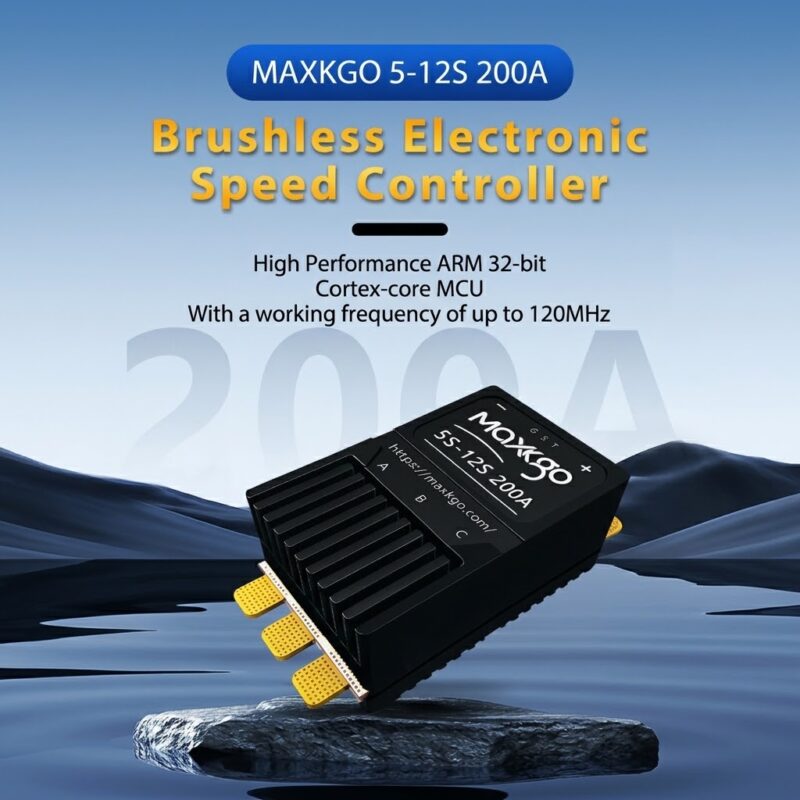
Auswählen eines Hochstrom-Regler for a powerful drone requires more than checking its rated amperage. If your UAV uses high-voltage LiPo batteries and brushless motors, an undersized electronic speed controller can limit power delivery and affect flight system reliability. You also need to consider battery compatibility, firmware configuration, Telemetrie, and protection functions before choosing a controller.
For professional FPV projects, industrial UAV platforms, and large multirotor systems, these details directly influence component selection and integration. The MAXKGO 5-12S 200A MINI ESC addresses these requirements with 200A continuous current, 250A burst current, AM32-Firmware-Kompatibilität, and DShot telemetry support.
Why Does Your Drone Need a High Current ESC?
An electronic speed controller regulates the electrical power supplied to a brushless motor according to flight controller commands. In high-power drone applications, the ESC must handle substantial current while maintaining stable communication with the control system.
A high current ESC becomes particularly important when your application involves:
- Large multirotor drones: Multiple motors can create substantial power demands during takeoff, Klettern, and maneuvering.
- Industrial UAV platforms: Equipment carrying additional payloads requires careful power system selection.
- Heavy-duty FPV drones: High-performance motors and demanding flight conditions require an appropriately rated ESC.
- Starrflügler: Motor and propeller combinations determine the current requirements throughout different flight stages.
Jedoch, a higher current rating does not automatically guarantee better performance. You should match the ESC rating to your motor specifications, Batteriespannung, propeller configuration, and expected operating current.
MAXKGO 5-12S 200A MINI ESC: Key Technical Specifications
The MAXKGO 200A MINI ESC is designed for high-power FPV drones, UAV platforms, und RC-Anwendungen. Its electrical ratings and firmware compatibility make it a candidate for projects requiring high-current brushless motor control.
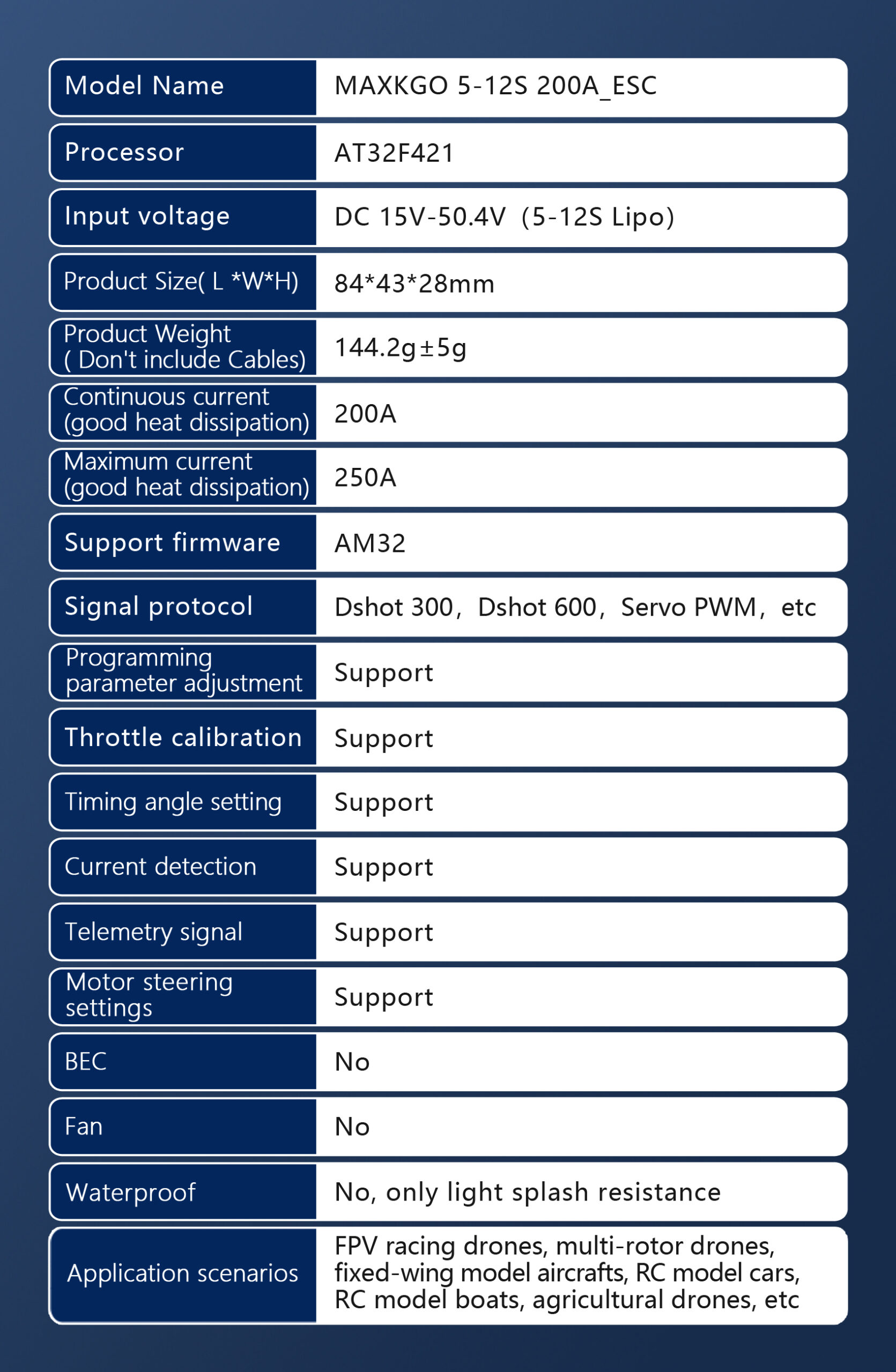
200A Continuous Current and 250A Burst Current
The controller supports 200A continuous current and 250A burst current. These ratings provide useful reference points when evaluating motor loads and selecting an ESC for your power system.
Vor der Installation, check the motor manufacturer’s current specifications and account for the combined electrical demands of your application. The burst rating should not be treated as a continuous operating rating.
5S–12S LiPo Battery Compatibility
The ESC supports 5S–12S LiPo batteries, providing flexibility when designing different high-voltage drone power systems.
This voltage range is relevant to applications that require higher-voltage battery configurations. Trotzdem, you should verify the battery voltage, motor compatibility, Verdrahtung, and connector ratings before connecting the system.
AM32 Firmware and DShot Telemetry
Firmware and communication protocols also matter when integrating an ESC into a drone.
The MAXKGO 200A MINI ESC features:
- AM32-Firmware-Kompatibilität: Supports configuration through compatible AM32 tools.
- DShot communication: Supports digital ESC communication protocols.
- Telemetry feedback: Provides feedback for compatible monitoring and control systems.
- ARM-Cortex-MCU: Uses an ARM Cortex-based microcontroller.
- Schutzfunktionen: Includes multiple protection features for electronic operation.
These functions help engineers configure and integrate the controller into compatible drone electronics.
Comparing ESC Current Ratings for UAV Applications
MAXKGO offers drone ESC products in 80A, 100A, 120A, and 200A current classes. The appropriate option depends on the electrical requirements of your specific drone rather than its size alone.
| ESC Current Rating | General Selection Consideration |
|---|---|
| 80FLUCHT | Systems with lower measured current requirements |
| 100FLUCHT | Applications requiring a higher current rating |
| 120FLUCHT | More demanding motor and power configurations |
| 200FLUCHT | High-current UAV and FPV power systems |
The 200A model is worth evaluating when your motor system requires a higher continuous current capacity. Jedoch, you should compare actual operating current, Batteriespannung, thermische Bedingungen, and installation requirements before making a purchasing decision.
How to Select and Integrate a 200A Drone ESC
Choosing the right high current ESC involves several practical checks. Follow these steps before placing an order or integrating the controller into your UAV.
- Calculate motor current requirements. Review the motor datasheet and estimate current consumption under your intended propeller and load conditions.
- Confirm battery compatibility. Make sure your battery configuration falls within the supported 5S–12S range.
- Check the current ratings. Compare expected continuous current against the 200A continuous rating. Consider the 250A burst rating separately.
- Verify firmware and communication. Confirm that your flight controller and configuration tools support the relevant AM32 and DShot functions.
- Review wiring and protection. Check cable sizing, Anschlüsse, Kühleinrichtungen, and the ESC’s protection requirements before installation.
- Test the integrated system. Follow the manufacturer’s installation instructions and conduct controlled electrical and operational checks before flight.
This process helps reduce component compatibility issues and supports more reliable UAV power system integration.
Why Consider MAXKGO for High Current ESC Solutions?
MAXKGO gehört zur Dongguan Daqianjin Technology Co., Ltd. Its technical background originated from the FLIPSKY team in 2017, with early experience in electronic speed controllers based on VESC firmware for DIY electric skateboarding.
In 2021, the company established the MAXKGO brand to focus on high-voltage, high-current battery management systems. It subsequently expanded into drone ESC development in early 2025, introducing 80A, 100A, 120A, and 200A product models.
This development path connects its experience in electronic control and battery protection with the requirements of drone power systems.
MAXKGO manufacturing and development activities include:
- Professional R&D focused on BMS and ESC technologies.
- Production processes covering assembly and final inspection.
- Quality control throughout manufacturing.
- Product development for drones, Robotik, Elektromobilität, und intelligente Energiesysteme.
For buyers evaluating an ESC manufacturer, these details provide useful background when assessing technical experience and potential supplier cooperation.
FAQ
1. What is a high current ESC used for?
A high current ESC controls brushless motor power in applications with substantial electrical demands. Typical uses include high-power FPV drones, multirotor UAVs, Starrflügler, and industrial drone platforms.
2. Can the MAXKGO 200A ESC work with a 12S LiPo battery?
Ja. The MAXKGO 5-12S 200A MINI ESC supports 5S–12S LiPo battery configurations. You should also verify motor compatibility and the complete system’s electrical specifications before installation.
3. Does the MAXKGO 200A ESC support AM32 and DShot?
Ja. The product supports AM32 configuration tools and DShot communication, together with telemetry feedback. Make sure your flight controller and other connected components support the required protocols.
Abschluss
Auswahl eines Hochstrom-Regler requires careful consideration of continuous current, Batteriespannung, firmware, Telemetrie, and motor compatibility. The MAXKGO 5-12S 200A MINI ESC combines 200A continuous current, 250A burst current, 5S–12S LiPo compatibility, and AM32 firmware support for demanding FPV and UAV power systems.
If you are developing a high-power drone or upgrading an existing UAV propulsion system, evaluate the MAXKGO 200A ESC against your motor and battery specifications. Contact MAXKGO to discuss product specifications, technical compatibility, and your project requirements.
