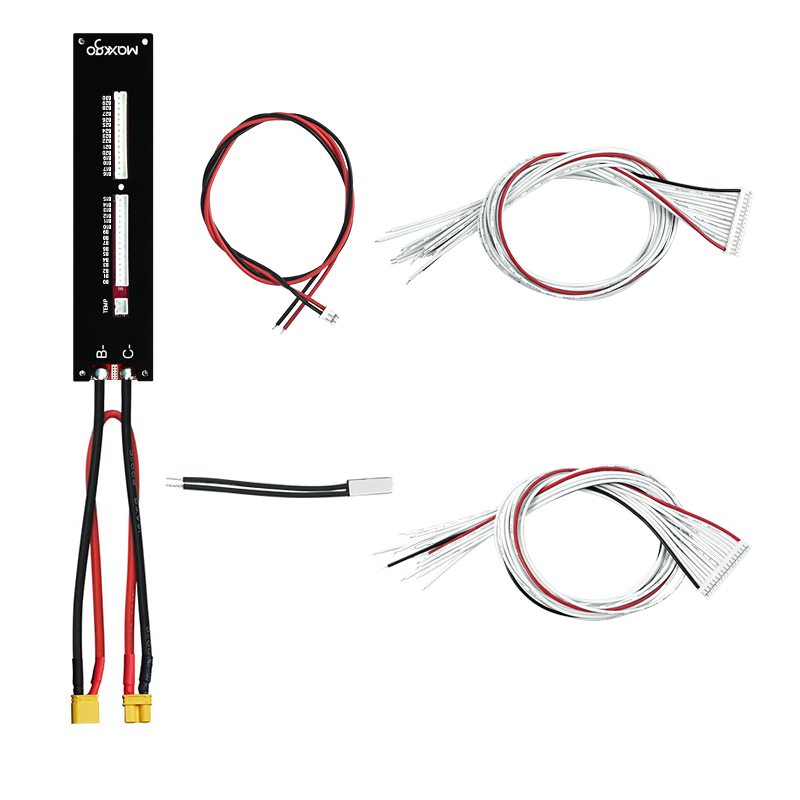


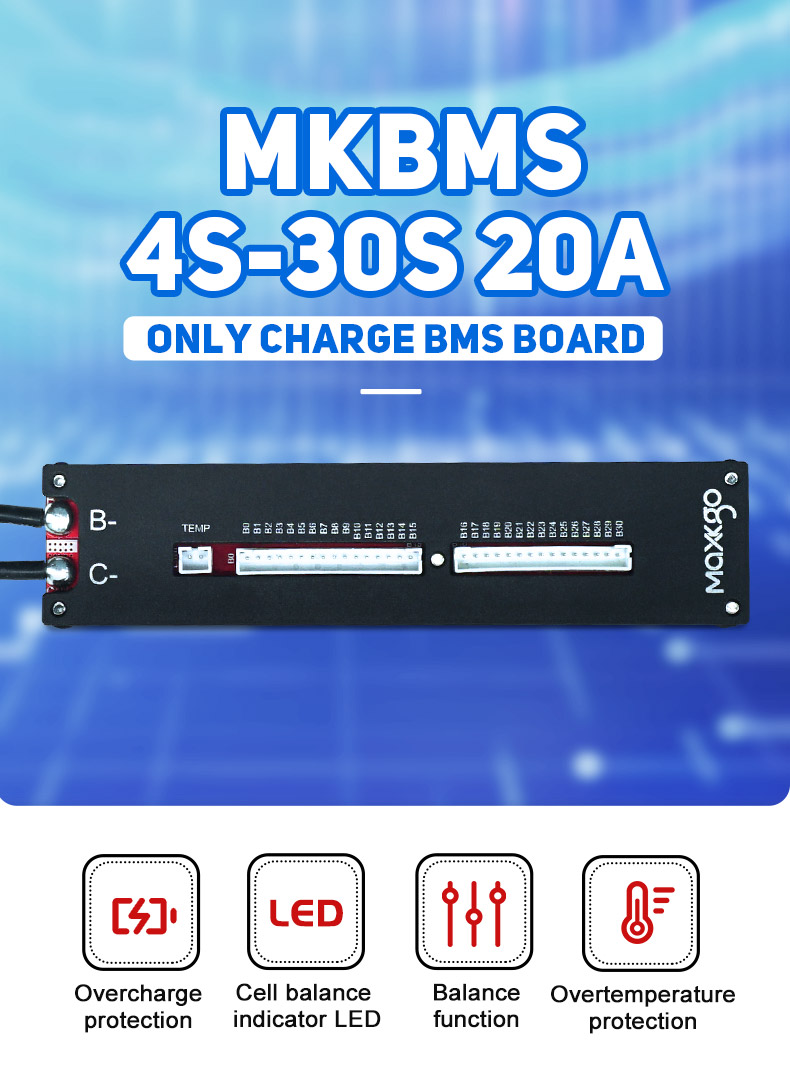
When you need controlled charging for a multi-cell lithium-ion battery pack, an Laden Sie nur BMS auf can solve a specific problem: protecting the pack during charging without adding discharge-control functions you do not need. MAXKGO’s 4S-30S 20A board supports lithium-ion packs from 4S to 30S, provides up to 20A charging current, and uses passive cell balancing. It also adds overcharge and overtemperature protection, while LED indicators help you monitor balancing activity. With an XT60 charging connector and a compact 130 × 30 × 11 mm design, this board fits applications where charging protection and space efficiency matter.
Why Choose an Only Charge BMS?
A charging protection board is not the same as a full battery management system designed to control both charging and discharging. If your battery architecture already has a separate discharge protection strategy, a charge-only design can provide a more focused solution.
The MAXKGO board is designed specifically for charging protection. You can use it with compatible Li-ion battery packs without configuration, while the passive balancing circuit helps manage cell voltage differences during charging.
Key functions include:
- 4S-30S series compatibility
- 20A maximum charging current
- Passive balancing at 4.2V
- 20–30mA balancing current at 4.2V
- Overcharge protection at 4.25V
- Overcharge reset at 4.19V
- Overtemperature protection at 60°C
- Overtemperature reset at 40°C
- LED indication for cell balancing
- XT60 charging connection
- Compact anodized aluminum heatsink case
4S-30S BMS Specifications and Protection
If you are selecting a 4S-30S BMS, voltage range and charging behavior should match your battery configuration. This MAXKGO model is designed for Li-ion cells with a nominal voltage of 3.7V per cell and supports configurations from 4S through 30S.
At the upper end, a fully charged 30S pack can exceed 127.5V DC. Therefore, you should treat wiring and installation as a high-voltage task and follow the specified B0-B15 and B16-B30 wiring sequence carefully.
| Feature | MAXKGO 4S-30S Only Charge BMS | Typical Full BMS |
|---|---|---|
| Main purpose | Charging protection | Charge + discharge management |
| Series range | 4S-30S | Depends on model |
| Charging current | 20A | Depends on model |
| Discharge protection | Not supported | Usually supported |
| Balancing | Passive | Active or passive |
| Ausgleichsstrom | 20-30mA | Depends on model |
| Balance indication | LED | Depends on model |
| Connector | XT60 | Depends on model |
| Configuration | No configuration required | May require configuration |
This distinction is important. Do not discharge the battery through this protection board, because it does not provide overcurrent discharge, undervoltage, internal short-circuit, or pack overtemperature protection.
How to Use a 20A Charging BMS Safely
For a 20A charging BMS, correct wiring is just as important as the electrical specifications. You can follow these basic steps:
- Confirm the battery configuration. Make sure your Li-ion pack falls within the supported 4S-30S range.
- Check cell voltage sequence. Verify that the voltage increases correctly from the B0 connection through the required balance connections.
- Connect the protection wiring. Follow the supplied GH2.0 and HY2.0 cable configuration rather than changing the wiring order.
- Connect the charging cable. Use the supplied XT60 charging cable and confirm polarity before applying power.
- Monitor balancing indicators. Check the LED indicators during charging to verify balancing activity.
- Keep discharge separate. Do not route battery discharge current through this charge-only board.
- Perform a controlled test. Check charging temperature, cell voltages, and protection behavior before putting the battery into regular service.
Where Can You Use an Only Charge BMS?
The compact design makes this board suitable for battery systems where you need dedicated charging protection. For example, you may consider it for electric skateboards, one-wheeled electric skateboards, electric scooters, electric bikes, and EUCs, provided the battery configuration and electrical design are compatible.
For a DIY electric skateboard, for instance, you can use the board as part of the charging architecture while keeping propulsion discharge management separate. This approach is particularly relevant when you are building or modifying a high-voltage battery system and want the charging function isolated from the discharge path.
MAXKGO brings experience from the electric skateboard and electronic control sector to its BMS development. The brand originated from the FLIPSKY team in 2017 and officially established MAXKGO in 2021 to focus on high-voltage, high-current BMS technology. Its manufacturing process includes assembly, inspection, testing, and quality control, while the company also presents certificate documentation and factory information for customer review.
FAQ
1. What is an Only Charge BMS?
An Only Charge BMS is a battery protection board designed specifically for charging-related protection and balancing. Unlike a full BMS, it does not provide discharge protection.
2. Can this BMS support a 30S lithium-ion battery?
Ja. The MAXKGO model supports 4S to 30S Li-ion battery configurations. However, a fully charged 30S pack can exceed 127.5V DC, so you must follow high-voltage safety and wiring requirements.
3. Can I discharge through this BMS?
No. This model is designed for charging only. You should not discharge through the board because it does not provide overcurrent discharge, undervoltage, internal short-circuit, or pack overtemperature protection.
Conclusion
If you need a dedicated Laden Sie nur BMS auf for a 4S-30S Li-ion battery pack, MAXKGO provides a focused charging-protection solution with 20A charging capability, passive balancing, LED balance indication, Überladeschutz, overtemperature protection, and an XT60 connector. Before purchasing, confirm your battery series count, charging current, wiring configuration, and separate discharge protection requirements.
CTA
Contact MAXKGO to confirm whether the 4S-30S 20A board matches your battery configuration. For technical evaluation, provide your cell chemistry, series count, charger voltage/current, and intended application so the team can help you select the appropriate BMS solution.