



Quando si progetta un pacco batteria ad alta tensione, monitoraggio cellulare affidabile, controllo coordinato, e l'architettura di sistema scalabile diventano considerazioni ingegneristiche essenziali. UN BMS ad alta tensione ti aiuta a gestire il funzionamento della batteria supportando al contempo le funzioni di protezione e monitoraggio richieste dalla tua applicazione. Tuttavia, la scelta di un sistema adatto implica molto più che il semplice controllo del suo intervallo di tensione. È inoltre necessario valutare le interfacce di comunicazione, architettura master-slave, compatibilità del firmware, e requisiti di integrazione. MAXKGO risponde a queste esigenze con il suo BMS HV Master, un sistema di gestione della batteria modulare progettato per configurazioni di batterie funzionanti con tensioni fino a 400 V. Con comunicazione CAN, un'interfaccia ISOSPI, Connettività USB-C, e un display OLED, questa scheda principale fornisce una base configurabile per gli sviluppatori che realizzano mobilità elettrica, robotica, e altri sistemi energetici intelligenti.
Cos'è un BMS ad alta tensione?
A high voltage battery management system monitors and manages a battery pack through connected sensing, control, and communication hardware. Depending on its design, a BMS can support cell-voltage monitoring, monitoraggio della temperatura, bilanciamento, fault detection, and protective responses.
For high-voltage applications, the system architecture matters because the battery pack may contain multiple cell groups and require coordinated communication between monitoring boards and the main controller.
MAXKGO’s HV Master BMS is designed around a modular master-slave architecture. Rather than relying on a single fixed board configuration, you can connect one or more slave boards and compatible integrated boards through the ISOSPI interface.
This approach gives developers greater flexibility when configuring battery management hardware for different pack sizes and application requirements.
Key Features of the MAXKGO High Voltage BMS
1. Configurable Operation Up to 400V
The MAXKGO HV Master BMS supports configurable battery systems operating within a voltage range of 100V to 400V. This makes it a candidate for projects that require a high-voltage battery management architecture rather than a conventional low-voltage BMS.
Prima di selezionare la scheda, you should confirm your battery’s nominal and maximum operating voltages, configurazione cellulare, and the voltage limits of every connected component.
2. Modular Master-Slave Architecture
The master board connects to one or more slave boards and compatible integrated boards through ISOSPI. Questa disposizione consente di organizzare l'hardware di monitoraggio della batteria in base alla progettazione del sistema.
I potenziali vantaggi includono:
- Configurazione flessibile per diversi layout del pacco batteria.
- L'hardware distribuito per il monitoraggio delle celle era supportato dalle schede collegate.
- Adattamento più semplice dell'architettura BMS ai requisiti specifici del progetto.
- Una struttura master-controller comune per coordinare i moduli collegati.
Il numero finale di celle e schede slave supportate dipende dalla configurazione hardware selezionata e dal firmware compatibile.
3. POTERE, USB-C, e interfacce OLED
La comunicazione e l'accesso alle informazioni di sistema sono importanti durante lo sviluppo e il test di un sistema di gestione della batteria.
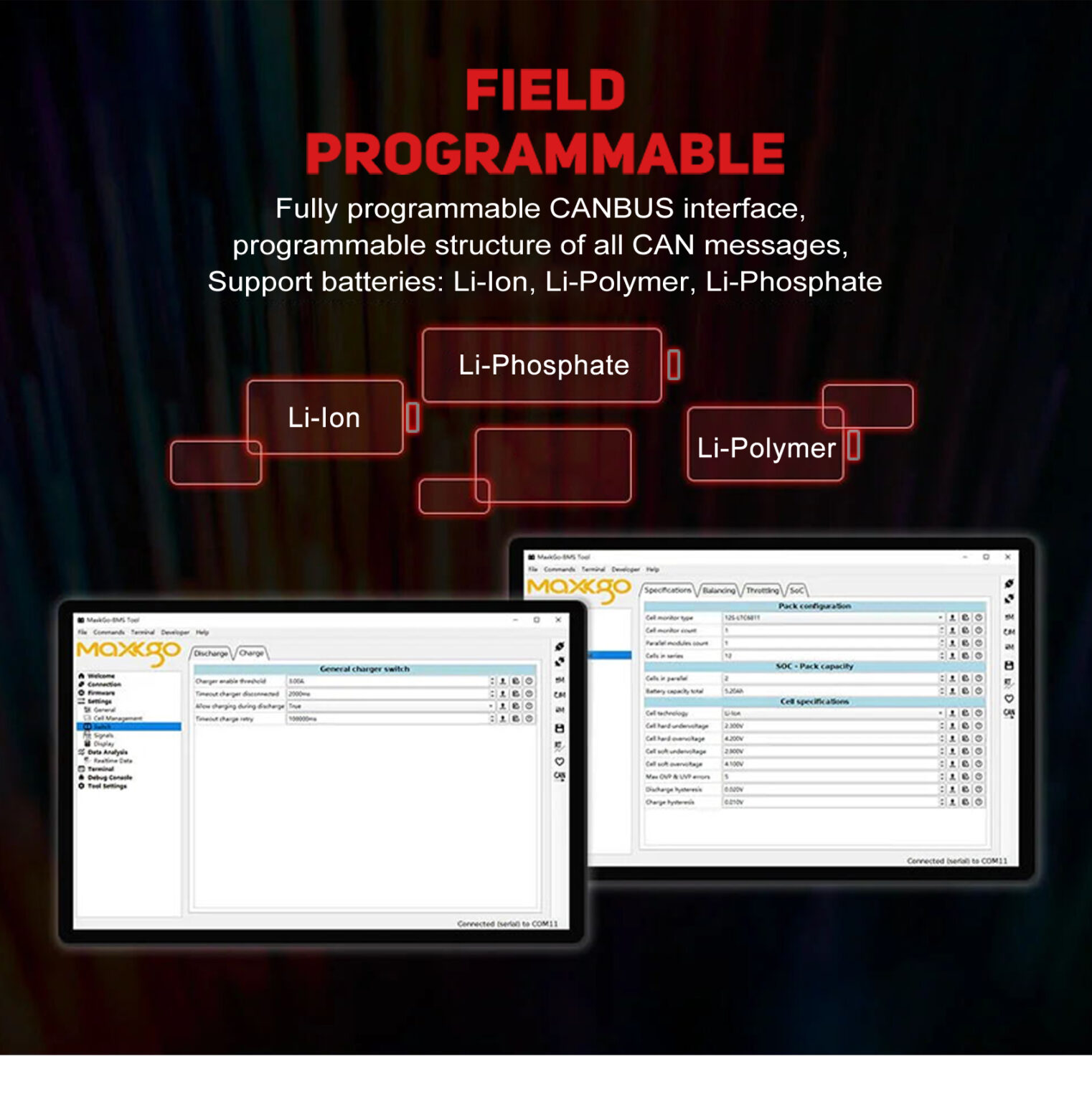
Il BMS HV Master include CAN, USB-C, e un display OLED. Queste interfacce possono supportare l'integrazione del sistema, flussi di lavoro di sviluppo, e visibilità dello stato locale, subject to the capabilities of the selected firmware and hardware revision.
CAN is particularly relevant when you need to integrate the BMS with other electronic controllers. Before implementation, verify the supported CAN protocol, message definitions, piedinatura del connettore, and communication settings.
4. LTC68XX, STM32, and ENNOID Compatibility
The MKBMS platform is designed for modular battery management systems using LTC68XX-related monitoring hardware and STM32 microcontrollers. MAXKGO also states that the product is compatible with ENNOID firmware and was developed with reference to open-source materials from DieBieMS and ENNOID BMS.
Per i team di ingegneria, firmware compatibility can reduce the need to develop an entirely new control framework. Nevertheless, you should confirm the exact hardware revision, firmware version, configuration procedure, and supported monitoring components before deployment.
High Voltage BMS vs. Conventional Low Voltage BMS
The appropriate BMS depends on your battery architecture and application requirements. The following comparison highlights general design considerations rather than claiming that every low-voltage or high-voltage system shares identical capabilities.
| Comparison factor | MAXKGO HV Master BMS | Conventional low-voltage BMS |
|---|---|---|
| Voltage application | Configurable systems within 100V–400V | Typically designed for lower-voltage battery packs |
| Architecture | Modular master-slave configuration | May use integrated or modular hardware |
| Comunicazione | CAN and ISOSPI interfaces | Depends on the selected model |
| Controller platform | STM32-based system compatibility | Varies by product |
| Firmware | Compatible with ENNOID firmware | Depends on the manufacturer |
| Integration priorities | High-voltage design and modular communication | Requirements depend on pack size and application |
Applications of a Modular High Voltage BMS
A modular BMS can be useful when your equipment requires coordinated battery monitoring across multiple cell groups.
MAXKGO identifies the following application areas for its HV Master BMS:
- Veicoli elettrici: Battery monitoring and control-system integration for compatible vehicle platforms.
- Veicoli elettrici da pattuglia e da turismo: Modular battery management for electric transport applications.
- Automatic forklifts and handling robots: Battery monitoring for industrial mobility and material-handling equipment.
- Electric bicycles and skateboards: Potential use in compatible high-voltage configurations, subject to the product’s electrical specifications.
- Robot di consumo e industriali: Battery management hardware for robotics projects with suitable voltage and communication requirements.
- Electric tools: Integration into compatible battery-powered equipment.
These are potential application areas, not confirmation that the board is suitable for every device in each category. You should assess electrical, mechanical, environmental, and regulatory requirements for your specific project.
How to Select and Integrate a High Voltage BMS
Follow these steps when evaluating the MAXKGO HV Master BMS for your project.
- Define your battery specifications. Document nominal voltage, maximum voltage, chimica cellulare, series-cell count, requisiti attuali, and operating temperature.
- Determine the monitoring architecture. Identify the required slave boards, integrated boards, cell-monitoring components, and ISOSPI connections.
- Verify communication requirements. Check CAN protocol compatibility, USB-C functionality, assegnazioni dei connettori, e integrazione del controller.
- Conferma la compatibilità del firmware. Verificare la versione firmware ENNOID appropriata, impostazioni di configurazione, e revisione hardware supportata.
- Esaminare i requisiti di sicurezza e conformità. Valutare l'isolamento, dispersione e gioco, controllo del contattore, protezione da sovracorrente, gestione dei guasti, e gli standard di prodotto applicabili. Non dare per scontato che queste funzioni o certificazioni siano incluse senza conferma.
- Convalidare il sistema completo. Chiedere a tecnici qualificati di rivedere il progetto e condurre test controllati prima di utilizzare la batteria ad alta tensione.
Domande frequenti
1. Quale intervallo di tensione supporta il BMS MAXKGO HV Master?
Il prodotto è configurabile per sistemi di batterie che funzionano tra 100 V e 400 V. Confermare i limiti precisi di tensione e le configurazioni delle celle compatibili con MAXKGO prima dell'acquisto.
2. Il BMS HV Master supporta la comunicazione CAN?
SÌ. The product specifies CAN connectivity, alongside USB-C, an OLED display, and an ISOSPI interface. Check the documentation for the relevant protocol and integration details.
3. Is the MAXKGO HV Master BMS compatible with ENNOID firmware?
MAXKGO states that MKBMS is compatible with ENNOID firmware. Confirm the applicable firmware version and hardware configuration before integrating it into your battery system.
Conclusione
Scegliendo un BMS ad alta tensione requires careful evaluation of voltage limits, modular architecture, interfacce di comunicazione, firmware support, and system-level safety. MAXKGO’s HV Master BMS offers a configurable 100V–400V platform with CAN, USB-C, OLED, and ISOSPI connectivity for compatible electric mobility, robotica, and intelligent power applications. By confirming your battery specifications and integration requirements early, you can determine whether this modular master board fits your project.
Request a technical consultation from MAXKGO. Share your battery voltage range, configurazione cellulare, required slave boards, CAN integration requirements, and intended application through the MAXKGO product inquiry page. The team can help you clarify hardware compatibility and identify the specifications you need to verify before implementation.
