



เมื่อคุณออกแบบชุดแบตเตอรี่ไฟฟ้าแรงสูง, การตรวจสอบเซลล์ที่เชื่อถือได้, การควบคุมการประสานงาน, and scalable system architecture become essential engineering considerations. ก high voltage BMS helps you manage battery operation while supporting the protection and monitoring functions required by your application. อย่างไรก็ตาม, selecting a suitable system involves more than checking its voltage range. You also need to evaluate communication interfaces, master-slave architecture, firmware compatibility, and integration requirements. MAXKGO addresses these needs with its HV Master BMS, a modular battery management system designed for battery configurations operating at voltages up to 400V. With CAN communication, an ISOSPI interface, USB-C connectivity, และจอ OLED, this master board provides a configurable foundation for developers building electric mobility, วิทยาการหุ่นยนต์, and other intelligent power systems.
What Is a High Voltage BMS?
A high voltage battery management system monitors and manages a battery pack through connected sensing, control, and communication hardware. Depending on its design, a BMS can support cell-voltage monitoring, การตรวจสอบอุณหภูมิ, สมดุล, fault detection, and protective responses.
For high-voltage applications, the system architecture matters because the battery pack may contain multiple cell groups and require coordinated communication between monitoring boards and the main controller.
MAXKGO’s HV Master BMS is designed around a modular master-slave architecture. Rather than relying on a single fixed board configuration, you can connect one or more slave boards and compatible integrated boards through the ISOSPI interface.
This approach gives developers greater flexibility when configuring battery management hardware for different pack sizes and application requirements.
Key Features of the MAXKGO High Voltage BMS
1. Configurable Operation Up to 400V
The MAXKGO HV Master BMS supports configurable battery systems operating within a voltage range of 100V to 400V. This makes it a candidate for projects that require a high-voltage battery management architecture rather than a conventional low-voltage BMS.
Before selecting the board, you should confirm your battery’s nominal and maximum operating voltages, การกำหนดค่าเซลล์, and the voltage limits of every connected component.
2. Modular Master-Slave Architecture
The master board connects to one or more slave boards and compatible integrated boards through ISOSPI. การจัดเรียงนี้ทำให้คุณสามารถจัดระเบียบฮาร์ดแวร์ตรวจสอบแบตเตอรี่ตามการออกแบบระบบของคุณ.
ผลประโยชน์ที่อาจเกิดขึ้น ได้แก่:
- การกำหนดค่าที่ยืดหยุ่นสำหรับรูปแบบชุดแบตเตอรี่ที่แตกต่างกัน.
- ฮาร์ดแวร์การตรวจสอบเซลล์แบบกระจายที่รองรับโดยบอร์ดที่เชื่อมต่อ.
- การปรับสถาปัตยกรรม BMS ให้เข้ากับข้อกำหนดเฉพาะของโครงการได้ง่ายขึ้น.
- โครงสร้างตัวควบคุมหลักทั่วไปสำหรับการประสานงานโมดูลที่เชื่อมต่อ.
จำนวนเซลล์และบอร์ดทาสสุดท้ายที่รองรับจะขึ้นอยู่กับการกำหนดค่าฮาร์ดแวร์ที่เลือกและเฟิร์มแวร์ที่เข้ากันได้.
3. สามารถ, USB-C, และอินเทอร์เฟซ OLED
การสื่อสารและการเข้าถึงข้อมูลระบบมีความสำคัญในการพัฒนาและทดสอบระบบการจัดการแบตเตอรี่.
HV Master BMS รวมถึง CAN, USB-C, และจอ OLED. อินเทอร์เฟซเหล่านี้สามารถรองรับการรวมระบบได้, ขั้นตอนการพัฒนา, และการมองเห็นสถานะท้องถิ่น, subject to the capabilities of the selected firmware and hardware revision.
CAN is particularly relevant when you need to integrate the BMS with other electronic controllers. Before implementation, verify the supported CAN protocol, message definitions, pinout ของตัวเชื่อมต่อ, and communication settings.
4. LTC68XX, STM32, and ENNOID Compatibility
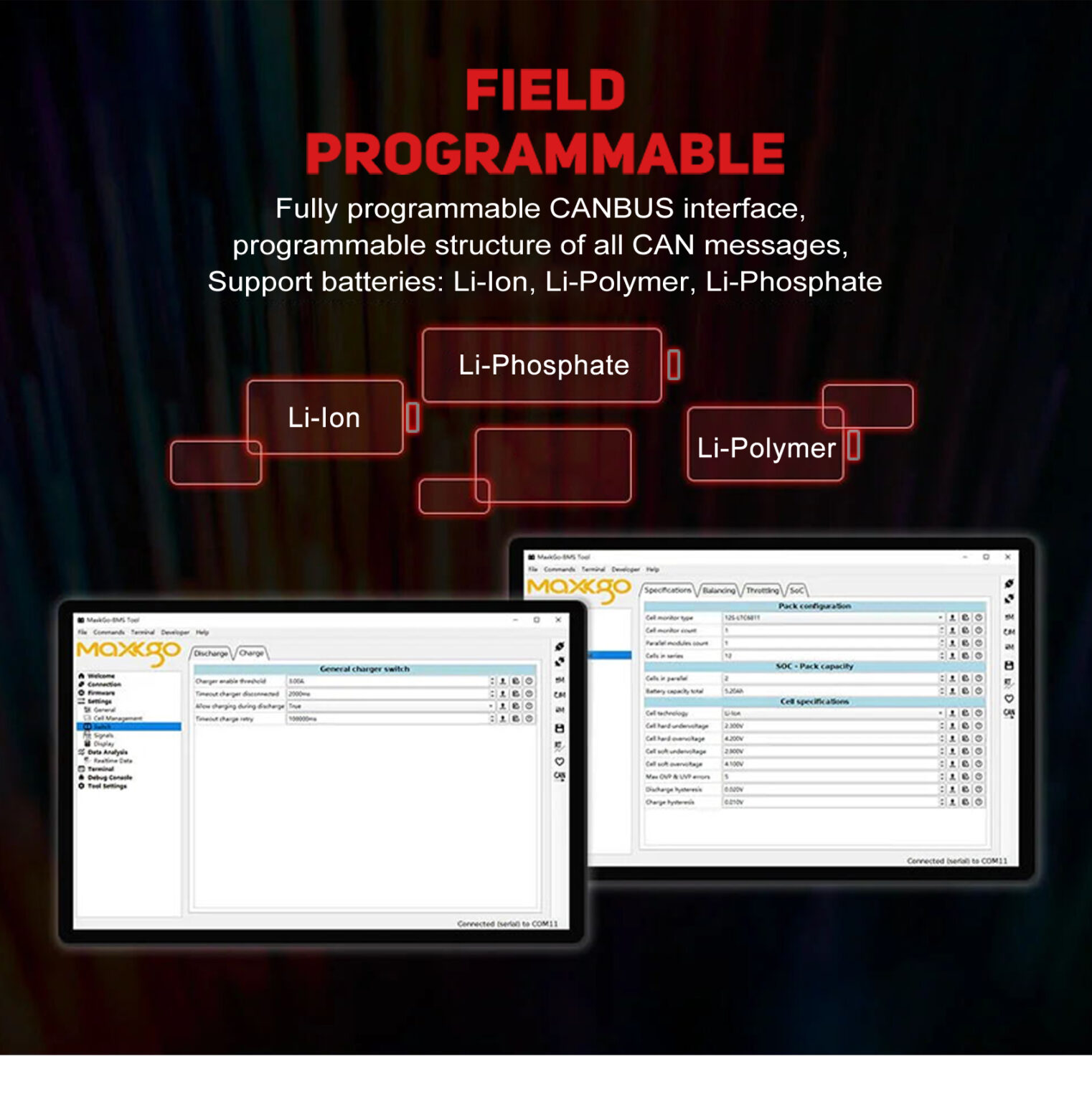
The MKBMS platform is designed for modular battery management systems using LTC68XX-related monitoring hardware and STM32 microcontrollers. MAXKGO also states that the product is compatible with ENNOID firmware and was developed with reference to open-source materials from DieBieMS and ENNOID BMS.
สำหรับทีมงานวิศวกร, firmware compatibility can reduce the need to develop an entirely new control framework. แต่ถึงอย่างไร, you should confirm the exact hardware revision, firmware version, configuration procedure, and supported monitoring components before deployment.
High Voltage BMS vs. Conventional Low Voltage BMS
The appropriate BMS depends on your battery architecture and application requirements. The following comparison highlights general design considerations rather than claiming that every low-voltage or high-voltage system shares identical capabilities.
| Comparison factor | MAXKGO HV Master BMS | Conventional low-voltage BMS |
|---|---|---|
| Voltage application | Configurable systems within 100V–400V | Typically designed for lower-voltage battery packs |
| Architecture | Modular master-slave configuration | May use integrated or modular hardware |
| การสื่อสาร | CAN and ISOSPI interfaces | Depends on the selected model |
| Controller platform | STM32-based system compatibility | Varies by product |
| เฟิร์มแวร์ | Compatible with ENNOID firmware | Depends on the manufacturer |
| Integration priorities | การออกแบบไฟฟ้าแรงสูงและการสื่อสารแบบโมดูลาร์ | ข้อกำหนดขึ้นอยู่กับขนาดบรรจุภัณฑ์และการใช้งาน |
การประยุกต์ใช้ BMS ไฟฟ้าแรงสูงแบบโมดูลาร์
BMS แบบโมดูลาร์จะมีประโยชน์เมื่ออุปกรณ์ของคุณต้องมีการตรวจสอบแบตเตอรี่ที่มีการประสานงานระหว่างกลุ่มเซลล์หลายกลุ่ม.
MAXKGO ระบุขอบเขตการใช้งานต่อไปนี้สำหรับ HV Master BMS:
- ยานพาหนะไฟฟ้า: การตรวจสอบแบตเตอรี่และการรวมระบบควบคุมสำหรับแพลตฟอร์มยานพาหนะที่รองรับ.
- รถลาดตระเวนไฟฟ้าและรถนำเที่ยว: การจัดการแบตเตอรี่แบบแยกส่วนสำหรับการใช้งานการขนส่งไฟฟ้า.
- รถยกอัตโนมัติและหุ่นยนต์ควบคุม: การตรวจสอบแบตเตอรี่สำหรับการเคลื่อนย้ายทางอุตสาหกรรมและอุปกรณ์ขนถ่ายวัสดุ.
- จักรยานไฟฟ้าและสเก็ตบอร์ด: การใช้งานที่เป็นไปได้ในการกำหนดค่าไฟฟ้าแรงสูงที่เข้ากันได้, ขึ้นอยู่กับข้อกำหนดทางไฟฟ้าของผลิตภัณฑ์.
- หุ่นยนต์ผู้บริโภคและอุตสาหกรรม: Battery management hardware for robotics projects with suitable voltage and communication requirements.
- เครื่องมือไฟฟ้า: Integration into compatible battery-powered equipment.
These are potential application areas, not confirmation that the board is suitable for every device in each category. You should assess electrical, mechanical, environmental, and regulatory requirements for your specific project.
How to Select and Integrate a High Voltage BMS
Follow these steps when evaluating the MAXKGO HV Master BMS for your project.
- Define your battery specifications. Document nominal voltage, maximum voltage, เคมีของเซลล์, series-cell count, ข้อกำหนดในปัจจุบัน, and operating temperature.
- Determine the monitoring architecture. Identify the required slave boards, integrated boards, cell-monitoring components, and ISOSPI connections.
- Verify communication requirements. Check CAN protocol compatibility, USB-C functionality, การกำหนดตัวเชื่อมต่อ, and controller integration.
- Confirm firmware compatibility. Verify the appropriate ENNOID firmware version, configuration settings, and supported hardware revision.
- Review safety and compliance requirements. Evaluate insulation, creepage and clearance, contactor control, การป้องกันกระแสเกิน, fault handling, and applicable product standards. Do not assume these functions or certifications are included without confirmation.
- ตรวจสอบระบบให้สมบูรณ์. Have qualified engineers review the design and conduct controlled testing before operating the battery at high voltage.
คำถามที่พบบ่อย
1. What voltage range does the MAXKGO HV Master BMS support?
The product is configurable for battery systems operating within 100V to 400V. Confirm the precise voltage limits and compatible cell configurations with MAXKGO before purchasing.
2. Does the HV Master BMS support CAN communication?
ใช่. The product specifies CAN connectivity, alongside USB-C, จอแสดงผล OLED, and an ISOSPI interface. Check the documentation for the relevant protocol and integration details.
3. Is the MAXKGO HV Master BMS compatible with ENNOID firmware?
MAXKGO states that MKBMS is compatible with ENNOID firmware. Confirm the applicable firmware version and hardware configuration before integrating it into your battery system.
บทสรุป
การเลือกก high voltage BMS requires careful evaluation of voltage limits, modular architecture, communication interfaces, firmware support, and system-level safety. MAXKGO’s HV Master BMS offers a configurable 100V–400V platform with CAN, USB-C, OLED, and ISOSPI connectivity for compatible electric mobility, วิทยาการหุ่นยนต์, and intelligent power applications. By confirming your battery specifications and integration requirements early, you can determine whether this modular master board fits your project.
Request a technical consultation from MAXKGO. Share your battery voltage range, การกำหนดค่าเซลล์, required slave boards, CAN integration requirements, and intended application through the MAXKGO product inquiry page. The team can help you clarify hardware compatibility and identify the specifications you need to verify before implementation.
